
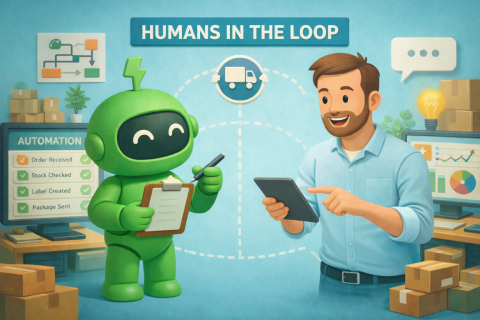
When automation enters the chat, it rarely arrives on completely neutral ground. Because the term “automation” tends to come loaded with assumptions, most of them rooted in efficiency. That automation is all about speed. About cost reduction. And ultimately, about removing friction by removing people.
On the surface, that framing is understandable. Software doesn’t need breaks. Workflows don’t forget tasks. Systems don’t rely on memory or mood. But in the rush to automate, many businesses design processes around what technology can do, rather than what customers actually want and need.
Because while automation is exceptional at handling logistics, in some use cases (especially where money is changing hands) it simply won’t be enough to replicate reassurance, context and trust. And in many buying journeys, those are the moments that matter most. The most effective automation strategies, therefore, aren’t human-free. They’re human-integrated. They don’t eliminate people from processes, they reposition them within them.
In this article, we’ll look at some of the ways in which automation and human touch points can interact to create blended flows end up being so much greater than the sum of their parts.
Automation’s Original Promise (and Its Blind Spot)
The first wave of business automation focused heavily on operational efficiency. Scheduling could be automated. Notifications could be triggered. Data could be captured automatically. Follow-ups could run without human input.
And, perhaps, rightly so. After all, these were genuine productivity gains. Teams were freed from repetitive admin. Response times improved. Manual errors decreased.
But something else happened alongside those gains. In many organizations, automation crept beyond logistics and into experience design. Human touch points were removed or compressed, often under the assumption that faster always meant better. It goes without saying that customers didn’t always experience it that way.
In high-consideration purchases especially, whether financial services, home improvements, healthcare, or complex B2B solutions, buyers still sought human reassurance. They wanted that “sense check” validation. Expertise. A sense that their specific situation had been understood.
Automation could move them forward. But it couldn’t always make them comfortable moving forward. This is where the blind spot in automation thinking begins to show: efficiency and effectiveness are not always the same thing.
The Rise of the Human-Integrated Flow
A more mature automation model has emerged in response, one that treats humans not as inefficiencies, but as high-value nodes – shining stars within a wider automated system.
In this model, automation doesn’t try to do everything. It focuses on what it does best: coordination, preparation and follow-through.
Before a human interaction ever happens, automation handles the groundwork. It captures data, qualifies leads, schedules meetings and removes administrative drag. So when a person enters the conversation, they do so well-informed and well-prepared.
Then comes the human moment: the consultation, the demo, the strategy session, the showroom visit. This is where empathy, persuasion and contextual judgment come into play. It’s where objections are surfaced and resolved. And, of course, where trust is built.
Afterward, automation picks up the baton again. Notes trigger workflows. Outcomes activate nurture paths. Follow-ups happen without delay. The result isn’t a tug-of-war between humans and technology. It’s a relay, with each stepping in where they create the most value.
A Practical Lens: The Showroom Journey
Consider the journey of a customer booking a showroom consultation, a setting where human interaction is central to conversion.
Without automation, the process is often fragmented. Booking requires back-and-forth emails. Staff enter meetings with limited context. Follow-ups rely on memory or manual reminders.
When automation is layered in thoughtfully, the dynamic changes entirely.
The booking process becomes self-serve, synced directly with staff calendars. Prospects provide project details, budgets and timelines in advance. Automated reminders reduce no-shows.
By the time the consultation happens, the human interaction is richer. The advisor isn’t gathering basics, they’re building proper vision, recommending solutions and addressing real concerns.
Critically, what happens after the meeting no longer depends on whether someone “gets around to it” after a busy afternoon or unexpected sick day. Attendance status, quote requests or next steps trigger tailored follow-up journeys automatically.
Automation hasn’t replaced the consultation. It’s made it more valuable, for both sides of the equation.
Where Humans Still Outperform Automation
Despite rapid advances in AI and workflow technology, there remain distinct zones where human involvement drives disproportionate impact.
Trust-building is undoubtedly one of them. Customers making meaningful financial or operational commitments often want to sense conviction in the person advising them. Scripts and automated responses rarely provide that reassurance (in fact, as we all know from personal experience, they can often have the opposite effect!).
Complex decision environments are another. When solutions are bespoke, whether configuring software, designing interiors or structuring financial plans, customers need guidance, not just information.
There’s also the realm of exception handling. Automation thrives on predictability. But real-world customer journeys are full of nuance: complaints, edge cases, unusual timelines, emotional responses. These moments require interpretation as much as action.
And finally, there’s conversion itself. Many final purchase decisions hinge less on information and more on confidence. A well-timed conversation, a reframed objection or a sense of partnership can tip decisions that automation alone might stall.
Operational Efficiency Without Experiential Loss
One of the misconceptions about human-integrated automation is that it dilutes efficiency. In reality, the opposite is often true.
When automation absorbs scheduling, reminders, data capture and follow-ups, human interactions become more concentrated and purposeful. So staff spend less time on admin and more time on revenue-generating conversations.
Meetings can start further along the decision curve. Support teams handle fewer preventable queries. Sales forecasting improves because interaction outcomes are consistently logged and tracked. In this sense, automation doesn’t just protect the customer experience, it can sharpen operational performance alongside it.
Designing for the Blend
Building a human-integrated automation flow requires a shift in design thinking. Rather than asking where humans can be removed, businesses must identify where they are most valuable, and design systems that elevate those important moments.
This starts with journey mapping. Where do customers interact with people? What happens before those interactions? How prepared are both sides? And what happens afterward?
From there, automation can be applied surgically: to remove booking friction, capture context, reduce no-shows and ensure momentum continues post-interaction. Read more about process-led automation here.
The Direction of Travel
As AI capabilities expand, the balance between automation and human input will continue to evolve. Machines will increasingly handle research, summarization, meeting preparation, and recommendation modeling.
But rather than making humans obsolete, this is likely to make them more specialized. Their role shifts from information delivery to advisory partnership. From task execution to decision guidance. From service provision to relationship stewardship. Automation doesn’t remove the human layer, it elevates the level at which the humans in the loop operate.
Humans In The Loop
Automation works best not when it replaces people, but when it works around their specialism.
When logistics are automated, humans are freed to focus on trust. When fact-finding is automated, conversations become more valuable. When follow-up is automated, opportunities stop slipping through gaps.
The result is neither fully manual nor fully automated. It’s orchestrated. And in that orchestration, humans aren’t the weak link in automation. They’re the point where automation becomes truly meaningful.