
Most automation conversations focus on the “happy path.” Abandoned carts. Welcome flows. Post-purchase upsells. Nice, clean, revenue-driving journeys.
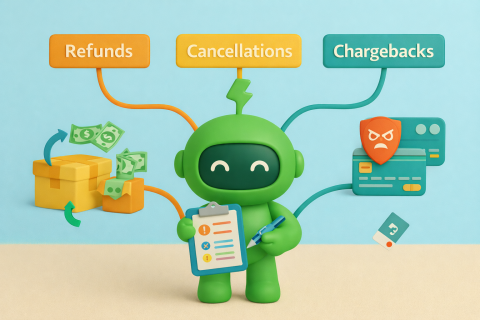
But ask most ecommerce teams where things actually get messy, and you might hear a different story - one that talks of partial refunds, last-minute cancellations and chargebacks that appear out of nowhere.
This is the operational gray area. The stuff that’s too complex to ignore and too risky to get wrong. You might naturally ask, can automation handle this? The short answer: yes. Longer answer: yes, but perhaps not in the exact way you’re thinking… Intrigued? Read on.
What Are We Actually Dealing With?
Before we get into the specifics of automation, it’s worth getting proper clarity on the problem with some definitions.
Partial refunds
These happen when only part of an order is refunded. Maybe an item was returned, damaged, or comped as a goodwill gesture. Simple in theory, but can be more chaotic in practice.
Order cancellations
These can happen before or after fulfillment. If you catch them early, great. If not, you’re suddenly dealing with logistics, awol inventory, and customer expectations all at once.
Chargebacks
The big one. A customer disputes a transaction with their bank, and you’re sucked into a process that’s a draining combination of admin, detective work and damage control. Lovely.
None of these are edge cases in terms of volume. Instead, they’re edge cases in complexity.
Why These Workflows Don’t Scale (Without Help)
There’s a reason some teams default to handling these manually. For a start, they involve multiple systems (Shopify, payment providers, support tools, the list goes on.) Additionally, no two cases are exactly the same. And to top it all off, the stakes are higher - there’s money, trust and reputation at stake. This all adds up to a frequent need for human judgment.
In practice, teams end up building organic but unofficial systems. This might feel familiar: Slack messages flying around, notes in tickets, someone who “just knows how to handle it?” But we all know this isn’t scalable. As volume increases, so do delays, inconsistencies and mistakes.
Where Automation Actually Fits (And Where It Doesn’t)
Let’s clear something up early on – automation isn’t here to replace important human decision-making. It’s here to support it.
What You Can Automate (Safely)
Automation quietly does its best work when it comes to “right action, right time” tasks - the important “heads up” moments that ensure you’re getting information levelled up correctly.
Some use case might include:
- Tagging orders when refunds or cancellations occur
- Notifying the right teams instantly
- Sending customer an instantly reassuring update (“We’ve received your request”)
- Routing tasks to the right person or system
- Updating internal data (LTV, customer status etc - handy when it comes to your VIP customers)
Where Should Humans Stay Involved
Even as an automation platform, we’re not about automating everything! There are still areas where you’ll definitely benefit from a human in the loop. These use cases might look like:
- High-value or unusual refunds
- Fraud-related chargeback decisions
- Complex, multi-item disputes
The beauty of automation is that with the “grunt work” taken care of, your team will actually have time to pour into these higher risk activities.
The Sweet Spot: A Hybrid Model
The best setups tend to follow a simple rule: Automate the predictable. Escalate the uncertain. Automation handles the 80% of steps that are repeatable. Humans step in for the 20% that require judgment. The result? Faster processes, fewer errors and less mental load on your team.
High-Impact Ecommerce Automation Use Cases
If you’re wondering where to start, these patterns are a solid place to start:
Partial Refund Workflows
- Automatically tag orders when a partial refund is issued
- Trigger follow-up emails tailored to the situation
- Update customer records (so your data reflects reality, not wishful thinking!)
Cancellation Flows
- Detect cancellation requests before fulfillment kicks in
- Pause or flag orders to prevent unnecessary shipping
- Notify warehouse or 3PL teams immediately
Chargeback Handling
- Flag high-risk customers or repeat disputes
- Automatically gather order data for evidence
- Alert support and finance teams the moment a chargeback is created
None of these remove complexity entirely. They just stop it from spiraling.
How Arigato Automation Helps You Do This Without Losing Control
This is where things get practical. Automation only works if it can handle nuance without becoming brittle. That’s exactly where Arigato tends to shine.
Event-Based Triggers (So Nothing Gets Missed)
Refund issued? Order canceled? Chargeback created? Arigato can trigger workflows instantly based on those events, no manual chasing required.
Conditional Logic (Because Reality Isn’t One-Size-Fits-All)
Not all refunds are equal. Not all cancellations follow the same path.
With conditional logic, you can:
- Treat high-value orders differently
- Route VIP customers down a different path
- Add checks and balances where needed
In other words, automation that behaves like a properly intelligent system, flexing to specific requirements and challenges regularly faced by your business.
Cross-System Coordination (The Bit Everyone Underestimates)
These workflows rarely live in one place.
Arigato helps connect:
- Shopify
- Support tools
- Email platforms
- Internal notifications
So instead of juggling tabs, your process actually flows. Check out our wide range of Shopfiy ecommece integrations here.
Templates You Can Reuse (And Improve Over Time)
Once you’ve built a solid workflow, you don’t have to start from scratch again.
You can:
- Save it
- Refine it
- Roll it out across stores (or clients, if you're an agency)
Good news for both consistency and your sanity!
Built-In Control (Because You Still Need It)
Crucially, automation doesn’t mean letting go of the reins entirely.
You can:
- Easily add in approval steps
- Automatically escalate edge cases
- Keep humans in the loop where it really matters
So you get the efficiency without the risk of things going sideways.
The Payoff: Why This Actually Matters
When you automate these “messy middle” workflows, a few things happen:
- Resolution times get faster
- Support teams spend less time on admin
- Errors (and awkward customer emails) decrease
- Customers get clearer, more consistent communication
- Your data becomes more reliable
All of this compounds over time, delivering value and impact that scales along with your business.
Getting Started (Without Overcomplicating It)
When it comes to getting started with automation, we always recommend looking at the problems that you actually have, before thinking about the automations you could deploy. Applying this mindset to partial refunds, cancellations and charge backs, this process might look something like...
- Mapping your current process (honestly, not ideally!)
- Identifying what’s repeatable vs what requires judgment
- Automating the repeatable 60–80% first
- Adding safeguards where needed
- Improving over time!
You don’t need a perfect system, just a better one than the one that isn’t quite working for you today.
Automation Isn’t Just for Growth
Many brands invest in automating for revenue. But fixing operational friction is often where the biggest long-term gains live. Less chaos. Better experiences. Happier support teams.
Automation in refunds, cancellations and chargebacks isn’t about removing humans from the process entirely. It’s about giving the process structure and dependable support. That’s where automation fits.